Nail Drill Bits Explained: Which E-File Bit Does What (With RPM Guide)
Carbide, diamond, ceramic and sanding bands explained: shapes, grits, RPM by job, safety, cleaning and the six bits a new tech should own first.
Carbide bits remove and shape enhancements (acrylic, builder gel, gel polish). Diamond and ceramic bits handle cuticle and natural-nail prep, and sanding bands on a mandrel do quick surface work and are thrown away after each client. Young Nails, a professional nail brand, recommends about 3,000 to 5,000 RPM on natural nails and 14,000 to 16,000 RPM for acrylic bulk removal.
Start with the material, not the shape
Every e-file bit is a metal or ceramic shank with an abrasive surface. The material decides what the bit can safely touch, so choose it before you worry about shape.
Carbide. Made from tungsten carbide, which one education brand describes as roughly twice as strong and dense as steel. Carbide has cut lines (flutes) that shave product off in curls instead of scratching it. That is why it is the standard for removing acrylic, builder gel and gel polish, and for shaping and shortening. Young Nails says you will "primarily use carbide bits" for enhancements. Carbide is not for the natural nail plate.
Diamond. A bit coated in diamond grit. It sands rather than cuts, so it is gentle and works well on natural nails and cuticle skin. Young Nails lists its diamond cuticle bits (round, ball and square) as 150 grit and uses them for cleaning up the cuticle area with light pressure. Diamond does not remove thick product efficiently.
Ceramic. Very durable like carbide, but usually less aggressive. Katie Barnes, a UK nail educator, notes that ceramic can help reduce the heat an e-file builds up, and that some bits are only ceramic-coated and will not last as long as solid ones. With correct technique, speed and pressure, heat should not be an issue with any bit.
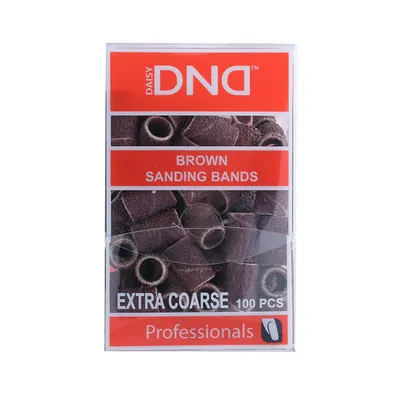
Mandrel plus sanding band. A mandrel is a small metal or rubber shaft that holds a disposable sandpaper band. It is the budget route for natural-nail prep, refining and gel removal. The band is replaced after every client, which makes this the simplest option for hygiene.
What each bit shape is for
Shape tells you where the bit can reach and how much surface touches the nail at once. These are the shapes you will see on almost every product page.
| Shape | Best for | Watch out for |
|---|---|---|
| Barrel (small or large) | Shaping the sidewalls and surface of enhancements, blending the product into the natural nail | Flat contact on a large barrel removes a lot of product quickly |
| Chamfer or safety barrel (smooth top) | Working near the cuticle and sidewalls, gel polish removal; the smooth rounded end lowers the chance of cutting the skin | Safety bits are made right-handed or left-handed. Match your dominant hand (Young Nails) |
| Cone / tapered | Reaching into the corners at the cuticle and around the sidewalls | The tip is smaller, so the same pressure lands on less surface |
| Ball | Light cuticle skin clean-up with the side of the bit | Never press the tip into the nail fold |
| Flame or needle | Fine detail around the cuticle and under the free edge | Easy to dig in. Light touch only |
| Bullet (under-nail cleaner) | Cleaning product and stains from under a grown-out free edge | Slender bit, keep it moving |
| Tornado or large cut barrel | Bulk removal of acrylic or hard gel and shortening length (Young Nails describes the tornado as perfect for this) | Fast and aggressive. Never near the cuticle |
| X-cut carbide | Longer shaft with a square edge to cut acrylic with minimal dust, good for smile lines and detail work (Young Nails) | Choose the left- or right-handed version |
| 5-in-1 | One bit with several shapes and grits in a single piece | Good starter bit, but always check which zone of the bit you are using |
You can browse every shape in our bits and bands collection. The Studio carries most of them, including 5-in-1, small and large barrel, chamfer, ball, needle and bullet styles in carbide, diamond and ceramic.
Grit: how coarse a bit cuts
Grit is how aggressive a bit is. Carbide bits are usually sold in a range from XXF (double extra fine) up to XXC (double extra coarse). On a carbide bit, grit comes from the flutes, not from particles. Deep, large flutes make a coarser bit and shallower flutes make a finer one. A 5-in-1 bit may combine two or three grits, for example XXF, XF and F on a fine version.
Diamond bits work the way sandpaper does, so a higher number means finer. Young Nails lists its natural-nail diamond bits as 150 grit, and describes a cross-cut coarse diamond bit as having a lower grit and therefore more power for enhancements.
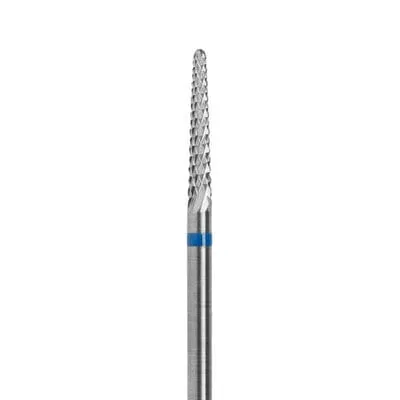
Brands also color-code the shank or ring, and the code is not universal. A blue band can mean medium on one brand and fine on another. Treat the color as a hint, then read the grit name on the product page before you buy.
How to choose a grit:
- Fine and extra fine: finishing, smoothing, gel polish removal, cuticle work, working close to the skin.
- Medium: everyday shaping of enhancements and blending.
- Coarse: bulk reduction of acrylic or hard gel, shortening length.
When in doubt, choose finer. A finer bit takes longer but forgives a slip. A coarse bit used by a beginner at the wrong angle can thin a natural nail plate in seconds. If you want the same idea for hand files, our nail file grit chart lines up file grits the same way.
RPM by job (and why sources disagree)
RPM means revolutions per minute: how fast the bit spins. Higher speed removes product faster and also builds heat faster. Beginners almost always go too fast.
| Job | Young Nails (pro nail brand) | Other published ranges |
|---|---|---|
| Natural nail prep with a fine bit or band | 3,000 to 5,000 RPM | Katie Barnes: mandrel bits 1,000 to 7,000 RPM on the natural nail |
| Cuticle area | Light pressure with diamond cuticle bits (no separate speed given) | A supplier guide: typically 7,000 to 15,000 RPM, and 10,000 or lower when you are learning |
| Gel polish removal | 8,000 to 10,000 RPM for beginners, 10,000 to 12,000 for pros | Safety bits are described as "around 12,000 RPM" |
| Acrylic bulk removal and shaping | 14,000 to 16,000 RPM | Katie Barnes: carbide 15,000 to 30,000 RPM, depending on technique |
The ranges overlap but do not match, which is normal. Handpieces, bit designs and technique all change how fast is too fast. Two rules hold across every source:
- Speed is a limit, not a goal. Just because an e-file reaches 35,000 RPM does not mean you should use it.
- Start at the low end of the range for the job and move up only if the bit stops cutting cleanly. If you have to push harder, the bit is dull, the grit is wrong or the speed is too low. More pressure is never the answer.
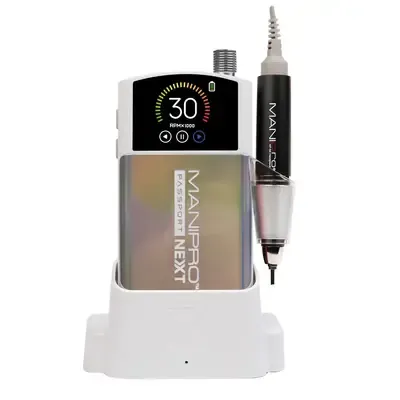
This is also why Young Nails stresses a machine with exact speed control instead of just low, medium and high. For a deeper look at speed settings, read our e-file RPM guide.
Safe technique: angle, pressure and heat
Most injuries and thin, ringed nails come from technique, not from the bit. Follow these basics.
- Hold it like a pencil and rest your hand on the client's hand or on the table so it cannot drift.
- Keep the bit flat to the surface, not pointing straight down into the nail. A bit used perpendicular to the nail digs.
- Keep it moving. Light, sweeping strokes, like painting with a very aggressive brush. Stopping in one spot creates a hot spot in seconds.
- Light pressure. The bit removes material by abrasion, not force.
- Use the right direction. Right-handed bits are meant to run in the forward direction. Left-handed techs use the matching left-handed version, which cuts when the e-file is set to reverse. If a bit feels like it is chattering or grabbing, check the direction before anything else.
- Stop if the client says it is hot or stings. Heat is a warning, not a feature.
Dust is the other safety issue. NIOSH, the CDC's workplace safety institute, recommends local exhaust ventilation at the table (portable units that filter or vent outdoors, or downdraft tables), gloves and an N95 respirator for nail technicians. We cover that in our nail dust collector guide.
Cleaning, disinfecting and replacing bits
A bit that goes from one client to another must be cleaned and disinfected in between. In Florida, salon rule 61G5-20.002 requires you to clean articles first, then fully immerse metallic instruments in a hospital-level or EPA-registered disinfectant, and store them clean in a closed container. The exact steps are in our how to clean nail drill bits guide.
A few bit-specific points:
- Carbide is easy to clean because the metal is non-porous. Brush out the flutes first, because product packed into them blocks the disinfectant.
- Sanding bands are not reusable. Throw the band away after each client and keep only the mandrel.
- Never clean the e-file handpiece or motor with acetone. Young Nails recommends an alcohol-based cleanser on the machine.
When to replace a bit. There is no universal number of services, so watch the bit. Replace it when it stops cutting without pressure, when flutes are clogged and will not clear, when the head wobbles or the shank runs out of true, or when the surface looks smooth, burred or discolored. A dull bit makes you press harder and creates heat. A wobbling bit chatters and can nick skin.
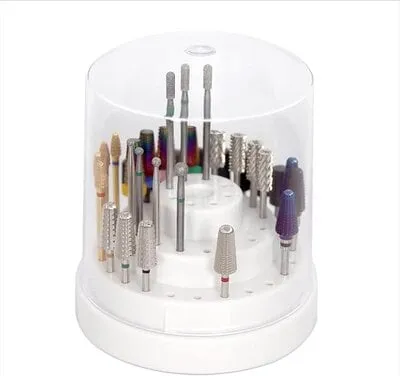
A bit holder keeps bits clean, separate and easy to find. We stock holders and cleaners in 6, 20, 25 and 48 hole sizes.
A starter set: six bits that cover most work
You do not need 40 bits. This set handles most manicure and enhancement services, and every type below is something The Studio sells.
- 5-in-1 carbide bit. A practical all-rounder for shaping and product removal. The Studio's 5-in-1 bits are our top sellers in the bits category.
- Small barrel carbide bit. For shaping and cleaning up the surface of the enhancement.
- Safety (smooth top) bit. For work near the cuticle and sidewalls, and for gel removal. Pick the left- or right-handed version for you.
- Diamond ball or bullet bit. For gentle cuticle area clean-up with light pressure.
- Ceramic cuticle clean bullet or tapered bit. A cooler-running option for natural-nail prep.
- Mandrel and sanding bands. A disposable option for natural-nail prep and refining. Pick a fine grit band for prep.
Pair them with a bit holder and a disinfectant setup. If you are still choosing your first machine, see best nail drill for beginners.
Right-handed, left-handed and size choices
Two details trip up new buyers more than any other.
Handedness. Young Nails says safety bits come in right-handed and left-handed versions to match the user's dominant hand. The same goes for X-cut carbide bits, which are sold as a right-handed and a left-handed pair. The cutting flutes are angled to pull product off when the bit spins in one direction. If you buy the wrong hand, the bit will still spin, but it will tend to grab, chatter or throw dust at you. Look for "RH" or "LH" or the words right or left in the product name, and check that your machine has a reverse switch if you are left-handed.
Size. Bits are sold as small, medium and large versions of the same shape. A small barrel reaches the sidewalls, a large barrel covers a lot of surface and removes product much faster. If you are learning, begin with the smaller sizes because they remove less per pass and are easier to control.
Shank. Most nail bits fit the standard 3/32 inch shank used by e-file handpieces, the size you will see on mandrel listings. Check your handpiece's collet size on its spec page before buying a bit from a different brand. A bit that does not seat fully will wobble.
What to check when you buy, and how to store bits
- Read the full product name. It should give the material, shape, size and grit (or color). If you cannot tell what a bit is from its name, skip it.
- Buy the same shape in two grits rather than ten shapes in one grit. A fine and a medium barrel cover more work than a bag of assorted shapes.
- Buy a few more than you need so you can rotate while one set is being disinfected.
- Check the finish. Look for even flutes with no burrs and a coating that covers the whole head.
- Store in a closed holder, upright, with the head up. Florida's rule requires clean, closed storage for disinfected articles, and a holder also protects the cutting edges.
- Label your grits. If the color ring is not clear, a dot of nail polish or a numbered holder slot saves guessing.
The Studio's holders come in 6, 20, 25 and 48 hole sizes. Pick the size that matches how many bits you actually own, with room to add a few more.
Troubleshooting: when something feels wrong
| Problem | Likely cause | Fix |
|---|---|---|
| Rings or grooves on the nail | Bit held at too steep an angle, or stopped in one place | Flatten the angle, keep sweeping, lower the pressure |
| Nail plate feels hot | Speed too high, too much pressure, bit clogged | Drop RPM, lift off for a moment, clean the bit or change it |
| Bit chatters or jumps | Wrong direction for your bit, bit not fully seated, or worn bit | Check forward/reverse, reseat the bit, replace if it wobbles |
| Product tears or smears instead of cutting | Bit clogged with dust, or too fine for the job | Brush out the bit. Switch to a coarser grit for bulk removal |
| Skin nicks near the cuticle | Coarse or sharp bit near the skin | Switch to a safety bit or diamond/ceramic for the cuticle zone |
| Fine dust everywhere | No capture at the table | Add a dust collector or downdraft table and keep the dust close to the source |
Which bit for which service
If you do not want to think about shape and grit every time, use this as a starting map. It uses the bit types explained above and the RPM ranges from Young Nails. Adjust to your own handpiece and technique.
| Service | Start with | Speed to start at |
|---|---|---|
| Natural nail prep before polish or gel | Fine sanding band on a mandrel, or a fine cross-cut or ceramic prep bit | 3,000 RPM, up to 5,000 |
| Cuticle area clean-up (dead skin only) | Fine diamond or ceramic ball, round or bullet bit | Low. Light pressure, side of the bit |
| Removing gel polish | Safety-style carbide bit, or a medium sanding band | 8,000 RPM as a beginner, up to 12,000 as a pro |
| Removing hard gel or builder gel | Medium or coarse carbide barrel | 10,000 to 16,000 RPM |
| Shaping and shortening acrylic | Coarse carbide barrel, tornado or X-cut | 14,000 to 16,000 RPM |
| Cleaning the sidewalls and under the free edge | Safety bit or slender bullet bit | Low to medium |
| Refining the surface and smoothing | Fine carbide or fine sanding band | Medium, light touch |
| Pedicure callus work | A dedicated pedicure disc or callus machine, not a nail bit | Follow the maker's manual |
For pedicure work there are purpose-built pedicure discs and callus files and machines. They are made for thick skin, so keep nail bits for the nail.
Shop what's in this guide
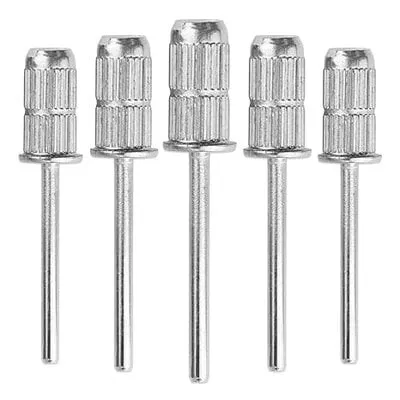
Bit - Mandrel - Silver - 3/32
Carbide Nail Drill Bit Holder - 48 Holes - Small - White
Brown Sanding Bands - Extra Coarse - 100 pcs
ProBit Nail Drill Bit - Cone - Blue - M - 119
ManiPro Next - White/Unicorn
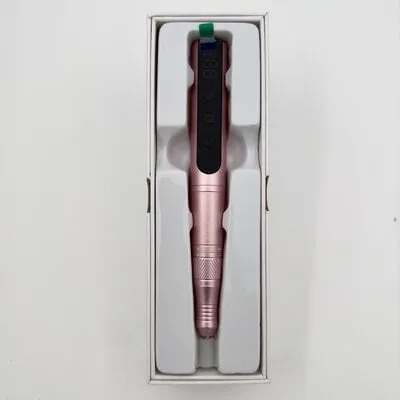
Cordless e-File Nail Drill - 35k RPM - Pink
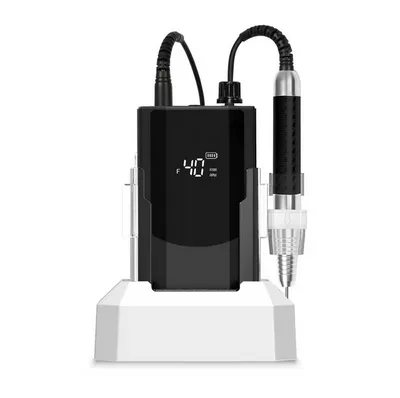
NAD - Portable Nail Drill - 40k RPM - 65 watts - Black
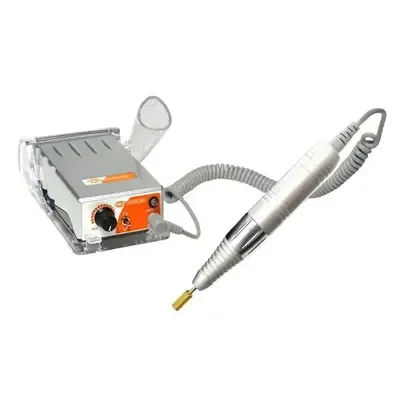
Pro Power 20K (30k) E-File Drill - Silver
Questions we get at the counter
What is the difference between carbide and diamond e-file bits?
What e-file bit is best for cuticles?
What e-file bit removes gel polish?
How do I know if a bit is for a right-handed or left-handed tech?
Can I use the same bit on every client?
How often should I replace my e-file bits?
Sources
- The Ultimate Nail E-File Guide: Essential Bits and How to Use Them, Young Nails
- What's the difference between diamond, carbide and silicone e-file bits, Scratch Magazine (Katie Barnes)
- E-File Bit Guide for Nail Techs: Shapes, Grits and Safe Use, Pure Spa Direct
- Fla. Admin. Code R. 61G5-20.002, Salon Requirements
- Nail Technicians: Workplace Safety and Health, CDC/NIOSH