Lash tweezers types: isolation, classic and volume, and which to buy
Straight, curved, boot, L-shaped and fiber tip lash tweezers explained by job, with a decision table, a quick fit test and care tips for lash artists.

Lash tweezers fall into three jobs: isolation tweezers separate one natural lash, classic pick-up tweezers hold a single extension, and volume tweezers pick up and place fans. Isolation tweezers come in straight and angled shapes, while volume tweezers are often boot, L-shaped, curved or S-shaped. Start with one isolation pair and one pick-up pair for your technique, then add specialty shapes only when your hands tell you what is missing.
Start with the job, not the shape name
Tweezer names are a mess. Stacy Lash's tweezer guide admits as much: different brands use slightly different labels for similar shapes, so the guide recommends thinking about what the tip actually helps you do instead of memorizing the alphabet.
Every lash set uses tweezers for two separate jobs at the same time:
- Isolation: separating one natural lash from its neighbors so you can work on it without bonding it to the next one.
- Pick-up and placement: holding an extension (classic) or a fan (volume) and setting it on the isolated lash.
Most artists hold one pair in each hand. That is why a lash tweezer is never a single purchase. You are really choosing a pair of tools that work together for your style of lashing.
Isolation tweezers
These are designed to separate natural lashes. Stacy Lash describes straight I-shaped tweezers as a good fit for artists who like a direct approach, and notes that C-shaped and F-shaped designs offer different angles for reaching natural lashes, including awkward inner and outer corners. The brand also lists A-shaped options in its range.
What to look for:
- Tips that meet cleanly. A gap lets lashes slip and leads to stuck neighbors.
- A shape that lets you see the lash line. If you have to twist your wrist to see what you are doing, the shape is working against you.
- Light, comfortable tension. You should hold separation without clenching.
In our range, The Studio carries an Isolation All Types straight tweezer in gold, and Elan carries Isolation Tweezers 2.0 in a curved shape. Both sit in lash tools and tweezers.
Classic pick-up tweezers
With classic lashing you pick up one extension at a time and attach it to an isolated natural lash. Stacy Lash says precision is the whole point: you need a reliable grip, controlled movement and tips that meet cleanly enough to hold a single extension without it flying across your station. A straight or appropriately curved pair can work well, depending on how you hold the tweezers and approach the lash line.
The guide also gives a useful warning. If you are constantly readjusting your grip or struggling to pick up individual lashes, do not assume you only need more practice. The tool deserves a place in the investigation too.
The Studio's Classic Pick Up Curved tweezer in gold is made for this job. If you are still learning, pair it with a straight isolation tweezer and a tray of classic extensions. Our guide to lash trays for beginners explains which trays to start with.
Volume tweezers: boot, L-shaped, curved and S-shaped
Volume is a different job. You are picking up several fine extensions and arranging them into a fan with a base you can place accurately, or you are picking up premade fans. Stacy Lash says this calls for tips and tension that suit your preferred fanning method.
| Shape | What it is known for | Good fit when |
|---|---|---|
| Boot | Angled tip with a useful pickup surface; angle and width differ between brands | You pinch or roll fans and want a defined working edge |
| L-shaped | Defined working edge that many artists find intuitive for fan making | You build fans from a tray and like a clear right-angle reference |
| Curved or S-shaped | Different hand angle to the lash line | You prefer a flatter wrist position or a different view of the fan |
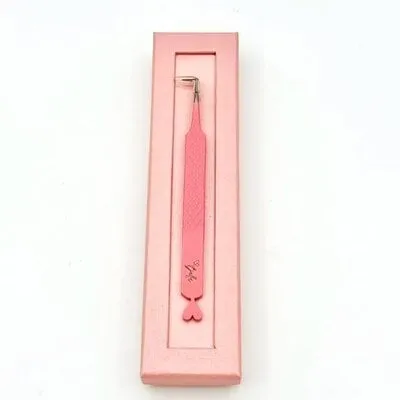
| Fiber tip | Textured tip designed for grip on fine fibers | Fans slip or collapse in smooth tips |
There is no universal winner. Stacy Lash's own answer to the best-tweezer question is that it is the combination of tip alignment, tension, grip and your technique, not the label or the fact that an educator uses them. The tips should hold the extensions securely without making you crush them together, and you should be able to pick up lashes, form the fan and release it without it falling apart.
The Studio's Volume Pick Up Curved tweezer in gold is made for this job. Love, Bella carries fiber tip tweezers in the same category. If you are learning to make handmade fans, read how to make lash fans next.
Quick decision table by job
| Your job | Look for | Examples in our range |
|---|---|---|
| Isolating natural lashes | Clean tip closure, a shape you can see past, light tension | The Studio Isolation All Types (straight), Elan Isolation Tweezers 2.0 (curved) |
| Classic extension pick-up | Controlled grip, a tip that holds one extension securely | The Studio Classic Pick Up (curved), The Studio Lash Tweezers in styles A and B |
| Volume fan pick-up | A pickup surface sized for your fan, tension that holds without crushing | The Studio Volume Pick Up (curved), Love, Bella Fiber Tip Tweezers |
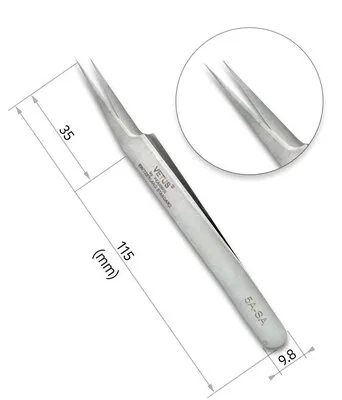
| Fine, general-purpose work | Fine tips, several shapes to compare | The Vetus Fine Tip range, including curved models such as the 5BSA and 7SA |
Check each product page for the exact shape and tip before you decide. Brands label the same shape differently, and Vetus model numbers do not always map neatly to the isolation-versus-volume categories.
A quick fit test before you commit
Stacy Lash suggests a simple test for isolation tweezers, and it works for any pair. Ask yourself:
- Can you see what you are doing without twisting your wrist?
- Can you keep lashes separated without pressing hard?
- Can you reach the inner and outer corners comfortably?
If the answer to all three is yes, you are on the right track. If not, try a different shape before deciding the problem is your hands.
For pick-up tweezers, add three more checks:
- Do the tips line up exactly when closed, with no crossing and no gap?
- Can you pick up an extension or fan with light pressure and release it cleanly?
- Does your grip stay relaxed after ten minutes of work, or do your fingers start to cramp?
Give a new pair a fair trial. Using one pair for a couple of weeks teaches you more than switching between many, as lash educators like Curacoro point out for fan making.
How many pairs do you actually need?
A sensible beginner kit is two pairs: one isolation tweezer and one pick-up tweezer that fits your technique. If you only do classic, a classic pick-up pair covers the second job. If you plan to move into volume, add a volume pick-up pair when your classic work is steady, rather than buying everything at once.
Artists who work fast often keep a spare of each pair in their station, because tweezers get dropped, bent and lost. A storage case keeps tips from touching other metal. The Studio carries tweezer storage cases in white, pink and black.
When your tweezers are the problem
Before you blame your technique, run through this table. Many "hand" problems are tool problems.
| Symptom | Likely cause | Fix |
|---|---|---|
| Extensions fly off when you pick them up | Tips misaligned or too much pressure | Check closure under light, try lighter pressure, replace a bent pair |
| Natural lashes keep sticking together | Isolation tip leaves a gap, or the shape blocks your view | Try another isolation shape and clean glue from the tips |
| Fans collapse in the tweezers | Pickup surface too narrow or tension too loose or too tight | Try a volume tweezer sized for your fan, or a fiber tip for grip |
| Wrist or hand pain after a set | Shape forces an awkward angle, or grip is tense | Test a different shape or weight, and relax your grip between placements |
| Hard to reach inner and outer corners | Isolation shape does not fit your approach | Compare straight and angled isolation pairs on practice eyes |
| Tips snag or scratch | Damage from a drop or from prying | Retire the pair. Do not use tweezers to open bottles |
Practice eyes are the cheapest way to compare shapes. The Studio sells practice silicon eyes so you can test a new pair without a client in the chair.
Keeping tweezers clean, aligned and safe
These are tools that sit near a client's eyes. The FDA's eye cosmetics guidance is clear on hygiene basics: wash your hands before applying and make sure any instrument you place near the eyes is clean. It also reminds users that eye-area reactions can be particularly troublesome because the skin is delicate.
- Clean tips between clients and follow your state board's rules for tool sanitation and the maker's care instructions.
- Remove dried glue from tips so they close cleanly. Glue buildup makes alignment problems worse.
- Never use tweezers for anything else. A tweezer used to open a bottle or pry a ring loses its alignment.
- Store them protected. Tip damage is permanent, and a bent tip causes the grip problems Stacy Lash describes.
- Replace any pair that no longer meets cleanly. Trying to bend it back rarely works.
If a client reports burning, swelling or discomfort during or after a service, stop and refer them to their doctor. The FDA also encourages reporting adverse reactions to cosmetics.
Shop what's in this guide

Lash Wash Bottle - Purple - 250 mL
Tweezers Fine Tip - 5ASA
Fiber Tip Tweezer - Pink - 4
Nose Hair Scissors - KM-604
Lash Glue Heart Rings - Hot Pink - 50 ct

Disposable Micro Applicators - White - 100 ct

Lash Glue Heart Rings - Blue - 50 ct